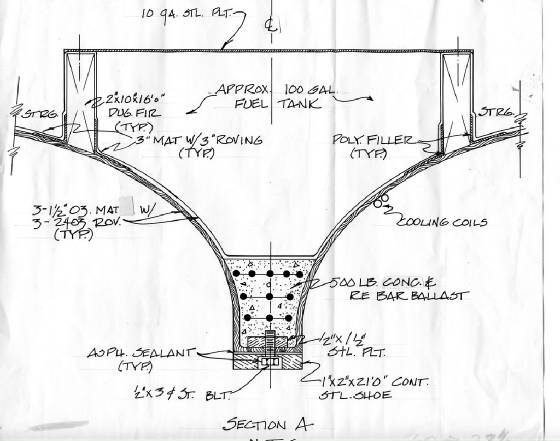
ENGINES; We use popular industrial diesels of approximately 1000 cc displacement, or 20 or so horses. Most of these have outputs for small hydraulic pumps,
accessory pumps and generators which can be added as required. All AW8m's are keel cooled and dry exhausted. These
systems are simpler and many times more reliable than the heat exchanger with wet exhaust systems used on most diesel
cruisers. There is nothing on the AW that isn't necessary or complimentary to its operation. These are designed
and built to operate 24 - 365.
LAYOUT;
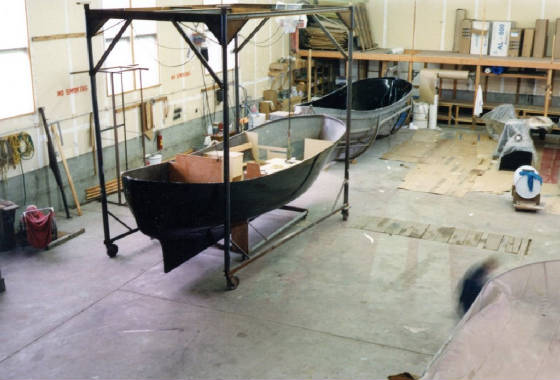
Our layout is designed for comfort aboard. Our centered pilot house and deep open keel results in a low center
of gravity vessel that is easy to handle with minimum roll. Our interior efficiency
is about the use of space. We probably get more out of the available space than any other builder.
The keel keeps the AW tracking straight thru whatever.
We build in several notable features: (1) Keel cooled - dry exhausted engine, (2) access to prop and rudder
from cockpit, (3) 8' cockpit to work from and in, (4) Self bailing cockpit, (5) 7/8" x 3" UHMW rubstrip
- toerail, (6) guaranteed no leak sky light, (7) protected running gear, (8) l" x 2" full length steel keel shoe,
(9) aluminum oxide gritted walkways, (10) dual helms, each with good visibility, (11) welded thru bolted hand rails, properly
located, (12) anchor system on bow, (13) lift brackets - both ends, (14) trailers nicely behind 3/4 ton pickup, (15) enclosed
semi-insulated cabin that heats easily, (16) 1/4 x 16 x 24 SS rudder.
CENTERED PILOT HOUSE: With the cabin sole located low - near the waterline- the AW pilothouse/cabin
gives by far the best ride under all sea conditions. Single operators can do their galley work underway. All systems
are easily monitored, including engine, fuel, electrical, etc. The cabin heats easily with a small heater. Underway,
the cabin/pilothouse is heated by an auto type heater that uses engine coolant.
An report from Juneau, AK in the 1980's confirms our contention that you
can't be too prepared. These men had completed their deer hunt and were preparing to AW home when they realized
icing conditions were a threat. Anyway, they had to stay put for a few days but were comfortable with their diesel range
and plenty of venison liver. At one time we had a picture of that boat with five deer hanging on the cockpit.
INTERIOR: The dinette makes into a full double bed
(54"). This bed sleeps well. Our dinette table is used in several fold-out configurations, and, when not
needed, is recessed under the bow berth. The AW has access forward through the bow double berth to the escape
hatch, or for handling the anchor through the forward hatch. The pilot and passenger seats tip ahead for more counter
space.
EXTERIOR: The AW's clean
lines help make passage through the water easier; they also make line handling and other utility activities more productive.
Our bow and stern lifting brackets support the AW for loading and make good tow bits. Should a rack be built over
the cockpit, it can be used as an enclosure for more living space, or as an overhead weather guard, or as a rack typically
used for storing skiffs, etc. We have set the AW up so a hung anchor line can be led around and tied off to the stern
lifting bracket.
CONCLUSION: Contrary
to accepted practice, the AW8m goes anyplace right out of the box. No flopper stoppers, bow or stern thrusters, weather
faxes, auto pilots, etc. North America would never have been discovered were any of these doodads necessary. The
AW is user friendly.
No
one has ever reported a snap roll in an AW8m. In fact, Ed Wood of Petersburg, Alaska, called and reported that his AW
sure handled the slop nice, and that two tows (trawling) caught all the shrimp he and his wife could eat in a year. The
level attitude of the AW8m underway facilitates activities only done on chined square-stern boats when they are securely tied
or anchored.
In the early 80's
we had three early model AW's that we chartered by the week. They worked fine and the average fuel consumed was
eleven gallons per week. However I would be the last guy to tell you that you could clean up financially by buying an
AW and chartering it. I was in an office in Bellingham that did that with a very popular, so-called "trawler yacht".
A participant in that scheme was there and pretty unhappy, his statement being that he spent more on repairs than he
received for rent.